Preparing your data for AI means getting it out of the scattered places it lives today (spreadsheets, your billing software, your customer list, WhatsApp, paper registers) and into one clean, consistent place a model can actually learn from. It is mostly tidying and organising, not coding, and it is the part that decides whether the AI works.
There are five steps, and a non-technical owner can follow every one: inventory your data sources, consolidate them into one place, clean the data, structure and label it, then check whether it is actually ready. Skip these and even the most advanced tool produces confident nonsense, because an AI model can only ever be as good as the data underneath it.
This is not a small detail to delegate and forget. Gartner predicts that through 2026, organisations will abandon 60% of AI projects that are not supported by AI-ready data (Gartner, 2025). The model is rarely the thing that fails. The data is.
Why this comes before the AI, not after
There is a persuasive myth that you buy a clever tool, point it at your business, and insights appear. In reality the tool inherits whatever mess it is fed. Two customers entered three different ways, dates in five formats, a “region” column that is sometimes a city and sometimes a state: the AI cannot tell these apart, so it learns from contradictions and hands you a forecast you cannot trust.
The cost of getting this wrong is not abstract. Gartner has estimated that poor data quality costs organisations an average of $12.9 million per year (Gartner, 2021), and research published in MIT Sloan Management Review found companies typically lose 15% to 25% of revenue dealing with the consequences of bad data (MIT Sloan Management Review, 2022). For a small or mid-sized business those percentages are the difference between a profitable year and a painful one.
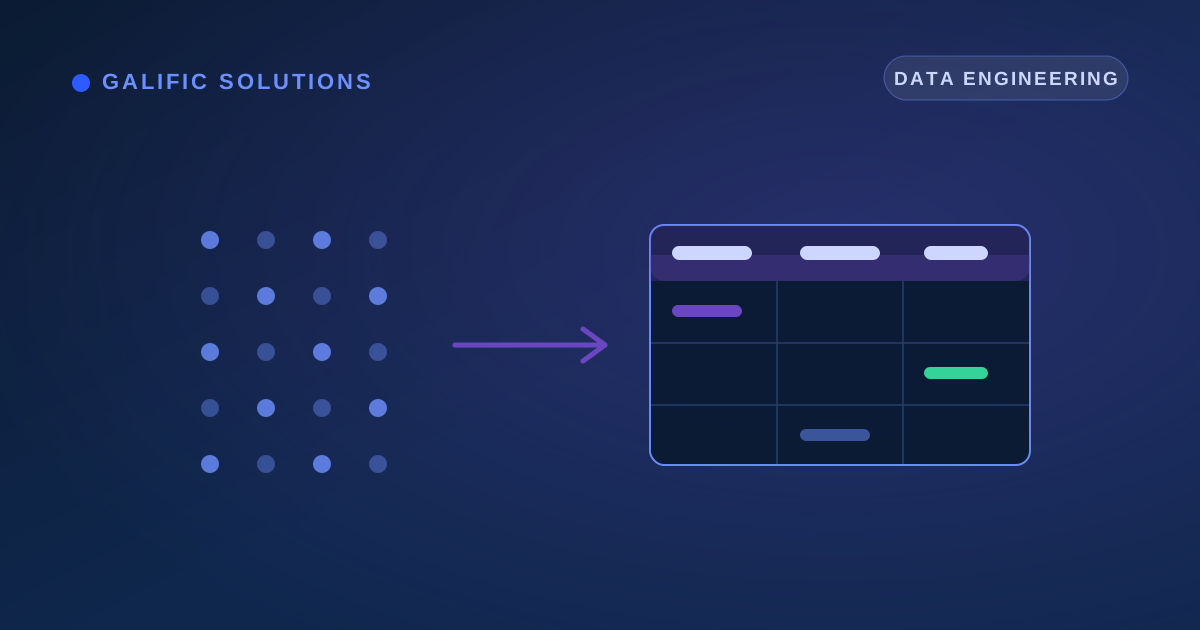
The encouraging part is that this is fixable, and it is work an owner can understand and direct. The path is always the same: scattered raw data becomes consolidated, then clean, then structured and labelled, until it is ready for a model to turn into a decision.
Step 1: Inventory every place your data lives
You cannot prepare data you have forgotten you own. The first task is a plain list of every system and surface where business information sits. For most Indian SMEs that list is longer than expected: the accounting or billing software (Tally, Zoho, an ERP), the customer list (a CRM, or honestly an Excel sheet), the point-of-sale or e-commerce platform, marketing tools, Google Analytics, supplier emails, order books on WhatsApp, and physical registers or ledgers.
For each source, write down three things: what it holds, how often it updates, and who owns it. This is the moment you discover the silos, the places where the same customer or the same sale exists in two systems with no link between them. Naming every source is what stops you building an AI project on half the picture without realising it.
Step 2: Consolidate everything into one place
Data spread across ten tools cannot be learned from as ten tools. It has to be brought together, copied into a single location such as a database or a central warehouse, so a model sees the whole business at once rather than one slice at a time.
The hard part of consolidation is not the copying, it is the matching. Your billing software might call a customer “Sharma Traders”, your CRM “Sharma Traders Pvt Ltd”, and your delivery sheet “M/s Sharma”. To a person these are obviously one customer. To software they are three, and any total built on top is wrong. Consolidation means agreeing on one shared identifier for each real customer, product, and supplier, and using it to stitch the sources together. This reconciliation work is the core of data engineering, and getting it right is what makes every later number trustworthy.
Step 3: Clean the data
Cleaning is the unglamorous step that matters most, and it is exactly the work that historically swallowed the largest share of a data team’s time: in Anaconda’s survey of data professionals, data preparation and cleansing took up roughly 38% of working time, more than model training and deployment combined (Anaconda, 2022). For a non-technical owner, cleaning comes down to four concrete jobs:
- Remove duplicates. The same invoice, customer, or order entered twice inflates every count. Each real thing should appear once.
- Fix inconsistent formats and units. Pick one date format, one currency, one way of writing phone numbers and GST numbers. Make sure weights, prices, and quantities use the same unit throughout, so 1.5 kg and 1500 g are not treated as wildly different sales.
- Handle missing values. Decide what happens to blanks. A few gaps can be filled with a sensible average or marked “Unknown”; a column that is mostly empty is usually better dropped than guessed.
- Standardise names and categories. “Mumbai”, “Bombay”, and “MUM” should become one value. “Pending”, “pending”, and “in process” should collapse to one status.
There is no skipping this. The oldest rule in the field still holds: garbage in, garbage out. No model, however advanced, repairs bad data on its own. It simply learns the errors and repeats them with confidence.
Step 4: Structure and label so a model can learn
Clean data still has to be shaped for a model. In practice that means a tidy table: each row is one thing (one customer, one order, one day of sales) and each column is one consistent fact about it (region, order value, days since last purchase). Spreadsheets where headings sit mid-page, or where one cell holds three pieces of information, have to be flattened into this simple grid first.
The step that owners most often miss is labelling. A label is the answer you want the AI to predict, recorded against past examples so the model has something to learn from. If you want to predict which customers will stop buying, your history needs a column that records which past customers actually stopped. If you want to forecast demand, you need the actual quantity sold against each past period. No labels means no learning, and it is the single most common reason an otherwise promising project goes nowhere. Where useful history only exists on paper, capturing it digitally through data digitization is what makes labelling possible at all.
Step 5: Assess whether the data is actually ready
Before anyone builds a model, it is worth honestly grading the data against a few questions. This is the heart of Galific’s audit-first approach: prove the data can support the work before spending on the build, not after.
“Good enough” data does not mean perfect data, and waiting for perfect is its own trap. It means the records are consistent enough, complete enough, and labelled well enough that the patterns the model needs are genuinely present. An audit’s job is to give you a clear yes or no on that, cheaply, before a single rupee goes into a full build.
The traps that quietly kill AI projects
Most failed AI work fails for the same small handful of reasons, and every one is a data problem an owner can spot early.
- Data silos. Each department guards its own “version of the truth”, so no source sees the whole customer. The fix is consolidation in step 2, not more dashboards.
- Inconsistent IDs. Without one shared identifier, the same customer counts as several, and totals, history, and predictions all drift. This is the most common silent error in SME data.
- No labels. Plenty of history, but no record of what actually happened, so the model has nothing to learn. Decide early what you want to predict, and make sure the past outcome is captured.
- Hoarding irrelevant data. Collecting everything “just in case” buries the signal that matters. Start from the decision you want to make, and prepare the data that decision needs.
- Letting quality decay. Data that was clean last year quietly rots as new records pile in. Simple validation rules (“revenue cannot be negative”, “GST number must be 15 characters”) and the odd check keep it usable.
Bringing it together
The whole point of this groundwork is that AI is only ever as strong as the data beneath it. Get the data right and even a simple model earns its keep. Get it wrong and the cleverest system on the market produces expensive, confident mistakes. That is why the order matters: consolidate, clean, structure and label, confirm readiness, then build.
This is precisely where Galific starts, with a low-cost data audit that tells you whether your data can support the AI you want before you commit to building anything. From there we consolidate and clean it through data engineering, turn paper and scanned documents into structured records through data digitization, and feed the result into the wider data intelligence and custom ML work. It is delivered from India and priced for small and mid-sized businesses, because the data foundation should not cost more than the insight it unlocks.
Preparing data for AI is not the exciting part. It is the part that decides whether the exciting part ever works.