Custom ML Systems - Galific Solutions

Demand Forecasting

Demand forecasting is no longer speculative with the advancement of AI and machine learning. At Galific Solutions, our innovative team builds custom ML solutions to analyze an organization’s performance based on historical sales, market trends, seasonality, and behavioral patterns to accurately predict future demand. This reduces market unpredictability. Additionally, our forecasts help you plan inventory, staffing, production, marketing, and procurement helping you avoid stockouts, overordering, and wasted expenditures.

Contact Us

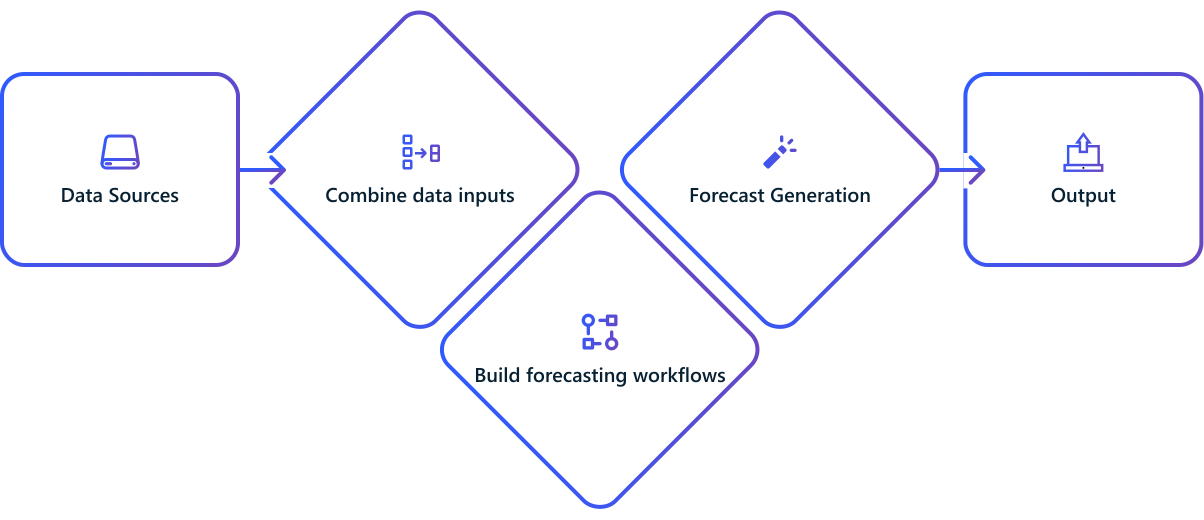
Step By Step Approach

Using a mix of historical trends, market signals, and behavioral data, we create forecasting systems that help you plan inventory, manage supply chains, and optimize pricing decisions with accuracy. Predict what’s next across SKUs, regions, or seasons.

chart

What Services will you get in Demand Forecasting?

count

Historical Data Analysis

Our AI-powered demand forecasting cleans and structures past sales data. It identifies the latest marketing and sales trends and detects anomalies to inform future decisions.

pattern
design
count

AI-Driven Forecast Modeling

We train custom ML models on domain-specific data sets. These models support both long-term and short-term demand forecasting down to the SKU level.

pattern
design
count

Real-Time Forecast Updates

Our models continuously learn from new data inputs and dynamically adjust to reflect real-world demand shifts in near real time.

pattern
design
count

Accuracy Monitoring

We track and tune forecasting models to improve accuracy with each cycle. Performance is benchmarked, and suggestions are applied for further optimization.

pattern
design

Industries We Support

We support several industries here are few:

icon
Finance & Fintech

Galific empowers financial institutions with AI for fraud detection, credit risk assessment, and automated reporting. Improve compliance and decision-making with real-time analytics.

Read more
icon
Retail & E-commerce

Galific helps deliver personalized shopping experiences, dynamic pricing, and smart inventory management. Improve conversions and streamline operations end-to-end.

Read more
icon
Manufacturing

We enable predictive maintenance, demand forecasting, and quality control through AI. Optimize resources, reduce downtime, and make faster data-driven decisions.

Read more
icon
Technology & SaaS Companies

We build AI models that enhance product functionality and automate backend workflows. Enable user behavior analysis, predictive features, and scalable deployments.

Read more
icon
Healthcare

From patient risk prediction to diagnostic support, our AI models assist in clinical decision making and operational planning. Drive better outcomes with real time intelligence.

Read more
icon
Supply Chain

Supply chains thrive on timing, accuracy, and cost control. Galific designs AI-driven solutions that forecast demand, optimize inventory levels, and streamline logistics—helping you move products faster and smarter.

Read more

Our trusted clients

Client Logo
Client Logo
Client Logo
Client Logo
Client Logo
Client Logo
Client Logo
Client Logo
Client Logo
Client Logo
Client Logo
Client Logo
Client Logo
Client Logo

How do we help?

Data Collection and Integration
We begin by gathering your historical sales data, seasonality trends, product movement, and external signals like market changes and events. This gives us a 360° view of the factors influencing your demand cycles.
Data Preparation and Cleaning
Next, we clean, align, and enrich the data by handling missing values, eliminating noise, and preparing it for machine learning. This ensures the models are trained on high-quality, actionable information.
Model Building and Customization
Our experts choose the right forecasting model for your business—ranging from time series and regression to deep learning. We train the models using your business-specific data to generate accurate demand predictions.
Accuracy Validation
We test each model using proven accuracy metrics like MAE and RMSE. Only the most reliable model makes it to production—one that reduces stockouts, overproduction, and revenue leakage.
Deployment and Optimization
Finally, we integrate the live model into your ERP or inventory system. The AI continues to learn from new data, keeping your forecasts aligned with changing consumer behavior and business goals.

General FAQs

Everything you need to know about the service and how it works. Can’t find an answer? Mail us at info@galific.com

  • How is AI responsible for the improvement of demand forecasting?
    Unlike traditional tools, AI can adapt to new data and ever-changing conditions in real-time. Moreover, it learns, extracts, and derives historical data from past patterns, real-time signals, and external data sources such as holidays or weather. Eventually, the AI tools would make continuous, accurate predictions.
  • What is the information required to start demand forecasting?
    Firstly, you need vital information such as sales history and SKU/product data. After that, it may become critical to consider promotional calendars to take into account supply constraints. Additionally, the need to factor in external elements such as market demand or footfall data becomes necessary to make a detailed forecast.
  • Will AI-ML models work for businesses with seasonal demand?
    Firstly, our models are trained and designed to detect and adjust for seasonal peaks, regional preferences, and event-driven fluctuations. Hence, you can be assured about the deliverability for businesses with seasonal demand.
  • How can I use these forecasts?
    Once your forecast is ready, you can synchronize it with your inventory system, dashboards, or use it to design marketing strategies. Moreover, the alerts, reports, and recommendations act as the guidelines for you to take the right actions at the right time.
  • What is the accuracy level of your forecasts on average?
    Initially, our AI-ML models deliver demand forecasting of 85–95% accuracy on valid and relevant data. Later on, the accuracy level of your forecasts would improve as you feed more data.