Data fragmentation in healthcare is when a single patient’s information is split across separate systems that do not talk to each other: the electronic health record (EHR) holds the visit notes, a lab system holds the blood work, imaging sits in another, the pharmacy and billing run on their own software, and older records are still on paper. No one place holds the whole patient, so no one can see the whole patient at once.
This is the problem to solve before anyone mentions AI analytics. A prediction is only as good as the data feeding it, and fragmented data feeds it half a patient. The fix is not a smarter algorithm. It is data engineering and digitization: pull the scattered pieces into one governed layer, in formats that agree, so that analytics finally has a complete picture to work on.
The country is already building toward this. India’s Ayushman Bharat Digital Mission crossed 90 crore Ayushman Bharat Health Account (ABHA) identities and over 100 crore linked health records in 2026 (National Health Authority, 2026). The plumbing for a connected patient record exists. The gap most clinics and hospitals still feel is local: their own systems do not share.
Why healthcare data is fragmented in the first place
Fragmentation is not carelessness. It is the natural result of how a clinic or hospital grows. Each function bought its own software at a different time, from a different vendor, to solve one job:
- Electronic health record (EHR): visit notes, diagnoses, prescriptions written during a consultation.
- Laboratory systems: blood work and pathology, often run by an outside diagnostic chain on its own portal.
- Imaging (PACS): X-rays, CT, and MRI scans, stored in a picture archiving system that rarely connects to anything else.
- Pharmacy: dispensing and stock, on separate billing software.
- Billing and insurance: claims and payments, tuned for finance, not clinical use.
- Paper and scanned PDFs: everything from before the software arrived, plus consent forms and handwritten notes.
Each of these is a small database holding one slice of the patient. None was designed to share, and the codes rarely match: one system writes “HbA1c,” another writes a LOINC code, a third writes free text. The patient is whole; the data about them is not. This is why fragmentation is a data problem first, not a software-shopping problem. Buying a seventh system usually makes it an eighth silo.
The real cost of fragmentation
Scattered data is not just untidy. It has a price, and clinics pay it every day.
Repeated tests. When the earlier lab result cannot be found, the test gets ordered again. Around 30% of tests are inappropriately repeated (Advanced Health Academy, reviewing published studies), and unnecessary tests and treatment waste at least $200 billion a year in the US health system (National Academy of Medicine, via Healthcare Finance News). Every repeat is a cost to the patient and a delay in their care.
Slower, riskier decisions. A clinician deciding without the full history is deciding on partial information. A missing allergy, an unseen prior scan, a lab trend nobody pulled together: each is a chance for an avoidable error. Completeness of the record is a safety issue, not a convenience.
Staff time burned on plumbing. When systems do not share, people become the integration layer. Front-desk and clinical staff re-key data between screens, phone the lab for a result that already exists, and stitch a history together by hand. That is time not spent on patients.
A broken patient experience. Patients repeat their history at every desk, carry their own films and reports, and wait while someone hunts for a file. Trust erodes with every retelling.
For a small clinic the burden is proportionally heavier. There is no large IT team to paper over the gaps, so the gaps land on the people meant to be delivering care.
How to unify it: integration, standards, digitization, and a governed layer
Unifying healthcare data is an engineering job with four moving parts. None of them is exotic, and the order matters.
1. Digitize what is still on paper
Anything on paper or trapped in scanned PDFs is invisible to analytics. The first practical step is turning those records into structured, coded fields a system can actually read, not images, but data. For most Indian clinics moving off paper, this is where the work begins, and it is the focus of our data digitization service.
2. Speak a common language with HL7 and FHIR
Systems can only exchange data if they agree on a format. HL7 is the long-standing healthcare messaging standard; FHIR (Fast Healthcare Interoperability Resources) is the modern version, built on ordinary web APIs so a lab system and an EHR can pass a result back and forth in a structure both understand (HL7 International). Underneath the format sit the terminologies that make a code mean the same thing on both sides: ICD for diagnoses, LOINC for lab tests, and SNOMED CT for clinical terms. Adopting these is what lets “HbA1c” in one system line up with the same test in another instead of becoming a duplicate.
3. Build one governed data layer
Once records are digitized and systems can speak FHIR, the pieces flow into a single governed data layer: a unified store where each patient has one record assembled from every source, deduplicated, with the codes reconciled. “Governed” is the operative word. Access is controlled, every read and write is logged, and the layer enforces who is allowed to see what. This is the data-engineering core of the whole effort, and it is the work behind our data engineering service.
4. Feed analytics from the unified layer, not from silos
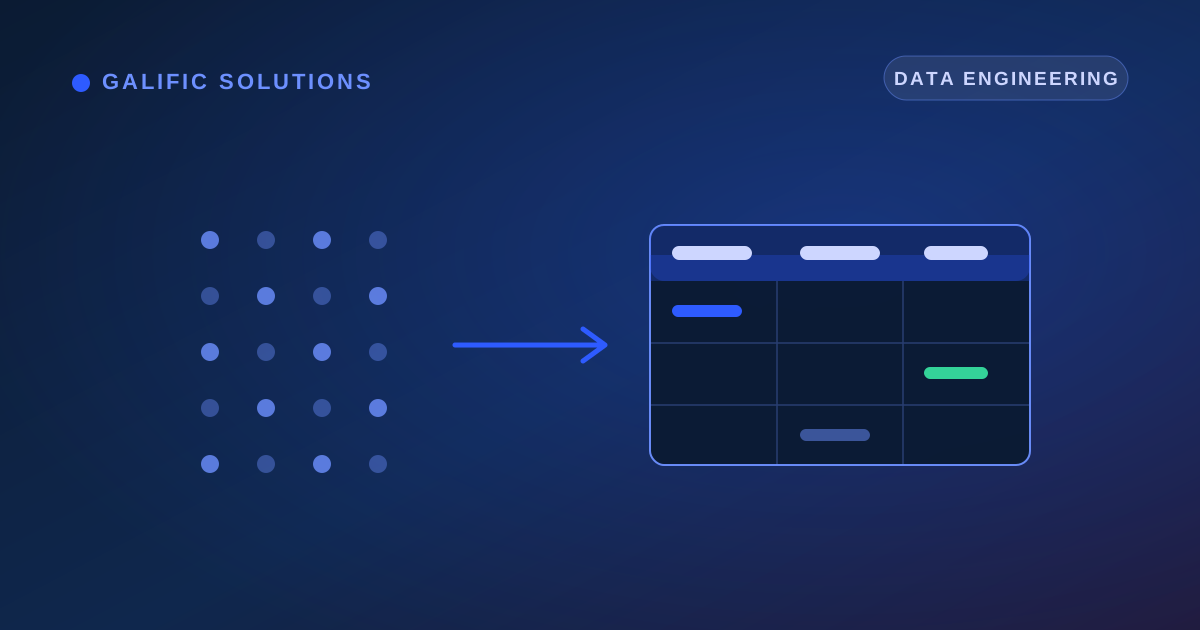
Only now does AI analytics have something solid to stand on. The flow below is the whole idea: scattered sources become one governed record, and that record is what analytics reads from.
This is the throughline of every data project: raw scattered data becomes structured data, structured data becomes intelligence, and intelligence becomes a decision. Skip the unification and the analytics is built on sand.
Privacy and compliance are part of the build, not an afterthought
Health data is among the most sensitive data a business holds, and unifying it raises the stakes, not lowers them. In India, the Digital Personal Data Protection Act, 2023 treats health data as sensitive personal data and sets the rules for how it is collected, stored, and shared. The national approach is worth copying at the clinic level: the Ayushman Bharat Digital Mission runs a consent-driven, federated model with no single central pool, where records are linked to a patient’s ABHA identity and shared only with consent (National Health Authority).
A governed data layer should follow the same principles. Access is based on consent and role, every access is logged for audit, data is encrypted, and you keep it on infrastructure you control. Privacy by design is not a tax on the project. It is what makes the unified record safe enough to use at all.
The analytics it unlocks once data is unified
With one complete, governed record per patient, analytics can finally do work that scattered data makes impossible:
- Readmission risk. A model can read the full history, recent labs, medications, prior admissions, and flag patients likely to be readmitted, so the care team can follow up before they return.
- Population health. Trends become visible across a whole patient panel: which cohorts are slipping on chronic-disease control, where preventive care is missing, which conditions are rising.
- Operational efficiency. The same unified data exposes waste that silos hide, duplicate tests across departments, idle imaging slots, slow discharge steps, so resources go where they are needed.
The appetite for this is real and growing. The global healthcare predictive analytics market was valued at $16.75 billion in 2024 and is projected to reach $184.58 billion by 2032, a compound annual growth rate of roughly 35% (Fortune Business Insights, 2024). The investment is flowing toward analytics, but it only pays off on data that has been unified first.
Start with an audit, not a platform
The cheapest mistake to avoid is buying an analytics platform before the data can support it. The right first step is an audit that maps every place patient data lives, what format each is in, which codes they use, and who can access them. That map shows the shortest, lowest-cost path to a single patient view, usually digitizing paper first, then connecting two or three core systems through standards before touching anything advanced.
This audit-first order is how Galific approaches healthcare data. We map and unify the data through data engineering and data digitization, build the analytics on top through data intelligence, and price it for Indian clinics and small hospitals rather than enterprise budgets. If your patient data is scattered across systems and paper, tell us where it lives and we will start with the map.
Fragmentation is not a reason to wait on better care. It is the first problem to solve, and once the data is whole, the analytics that improves outcomes follows.