Case Study

Construction Forecasting Engine (KROO)

Plan smarter. Build faster. Save up to 24% on project costs

A real estate development firm approached Galific with years of construction project data—historical budgets, vendor invoices, material costs, and timelines. They were experiencing cost overruns and pricing inconsistencies but weren't certain what intelligence could be extracted. Rather than making upfront commitments, we proposed a data audit to assess what their data could realistically deliver.

The audit revealed valuable patterns: pricing anomalies across similar projects, predictable cost correlations based on location and materials, and benchmarking opportunities to validate future vendor quotes. With this intelligence confirmed, we knew we could build KROO—an AI-powered forecasting engine that turns historical construction data into accurate project cost predictions.

We helped design the platform’s:

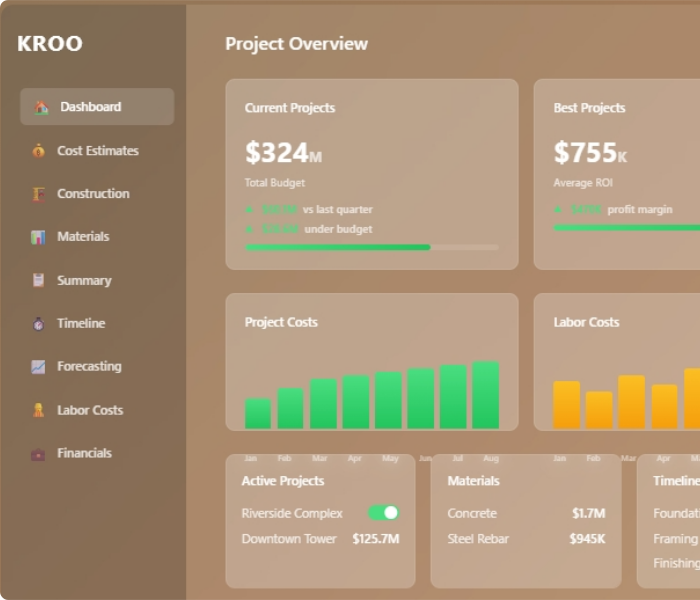
Predictive cost modeling engine trained on audited historical data Real-time anomaly detection for labor and material pricing Regional benchmarking system for vendor quote validation Detailed cost breakdown dashboards across all project categories
dash

Key Highlights

The Challenge

Construction budgeting is plagued by fragmented quotes, changing material rates, and hidden costs. Developers often discover pricing mismatches too late, leading to inflated project budgets and negotiation bottlenecks.

The Audit-First Approach

After reviewing the client's historical project data, our audit identified that their dataset contained sufficient intelligence to forecast costs accurately and flag pricing anomalies. This wasn't about building what they asked for—it was about building what their data proved was possible.

The Solution

Forecasting from Day Zero

KROO lets users input basic project parameters—square footage, location, timeline, and material preferences—and runs them through a trained model built on past project data and market pricing trends.

Smarter Decision-Making

The tool provides a detailed cost estimate split across labor, materials, permits, and contingencies, so developers can spot high-cost areas early and negotiate better.

Anomaly Alerts

The platform flags any unusual patterns, such as a concrete price that's too high for that region or a labor cost spike inconsistent with local rates.

The Results

01

Up to 24% Reduction in Cost Overruns - Developers saved 18-24% on projects by catching inflated quotes before contract signing. One commercial project alone avoided ₹2.3 crore in unnecessary material costs.

02

3x Faster Vendor Negotiations - Armed with data-backed benchmarks, procurement teams reduced negotiation cycles from weeks to days. Vendors could no longer justify arbitrary pricing.

03

150+ Pricing Anomalies Detected in 6 Months - KROO flagged overpriced concrete, inflated labor rates, and suspicious permit costs across 100+ projects—all before breaking ground.

04

₹50L+ Monthly Savings - Mid-project price escalations dropped by 67%. Clear upfront forecasts eliminated surprise costs and change orders during construction.

05

Decision Time Cut from Weeks to Hours - Project feasibility assessments that took 2-3 weeks now complete in under 2 hours, enabling faster capital deployment and competitive bidding.

06

Sharper Vendor Accountability - Transparent, data-driven cost breakdowns forced vendors to justify pricing, leading to more honest quotes and long-term partnership improvements.

07

Improved Budget Accuracy by 40% - Initial cost estimates now align within 5-7% of actual project spend, compared to 30-40% variance before KROO implementation.

Key Technologies Used

Engine Layer

Predictive Modelling Predictive Modelling
Anomaly Detection using ML logic Anomaly Detection using ML logic

Front-End Development

ReactJS ReactJS

Conclusion

KROO brought clarity to a chaotic part of construction—early-stage budgeting. Galific's audit-first approach ensured we only built intelligence systems that the client's data could actually support. The result: an AI-powered tool that turns past project data into smarter forecasting, helping real estate developers plan better, negotiate sharper, and build faster.